The steel industry is a core pillar of industrial and economic development, supplying essential materials for construction, manufacturing, infrastructure, and engineering. Within this industry, flat bars play an important role by supporting foundational stability, fabrication efficiency, and large-scale industrial production.
What Are Flat Bars?
Flat bars are steel products with a rectangular cross-section, manufactured in different widths and thicknesses to suit various applications. They are typically produced through hot rolling or cold drawing processes, depending on the required finish and dimensional accuracy.
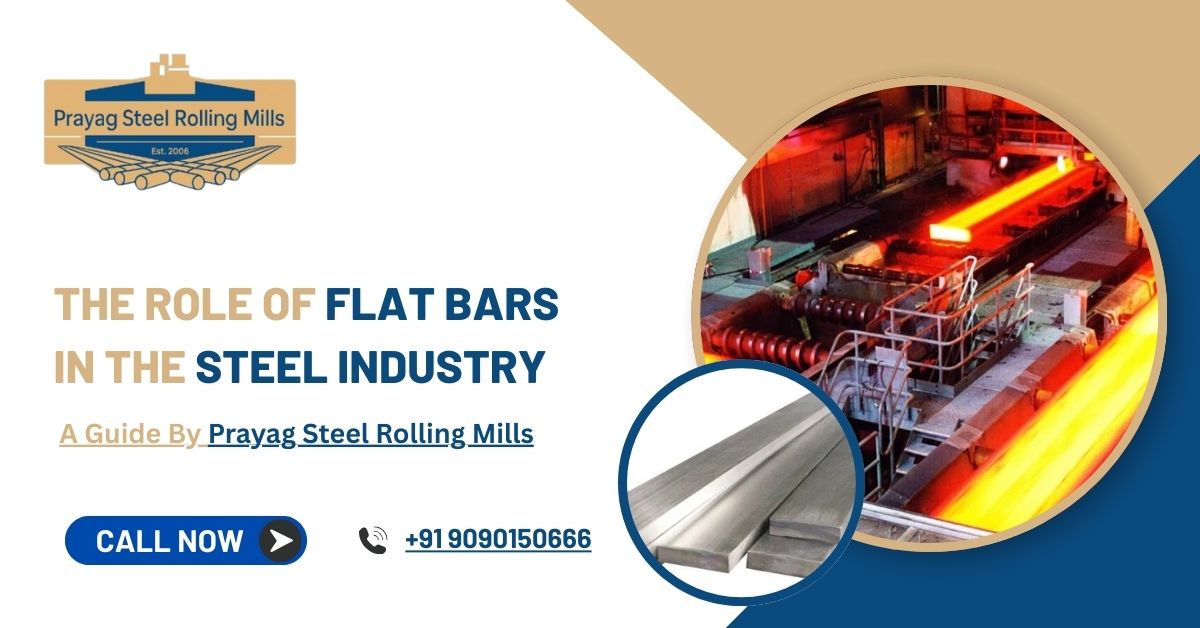
Because of their uniform shape and consistent quality, flat bars are easy to cut, weld, drill, and machine, making them suitable for both heavy-duty and precision-based work.
Importance of Flat Bars in the Steel Industry
Flat bars act as a core material in the steel supply chain. Many finished steel components begin as flat bars before being processed into frames, brackets, supports, or custom-fabricated parts. Their reliability helps maintain foundational stability, safety, and performance across a wide range of industries.
The steel industry relies on flat bars for their balance of strength, flexibility, and cost-efficiency, especially in projects where durability and load-bearing capacity are essential.
Types of Flat Bars Used in the Steel Industry
Different industrial needs require different types of flat bars. The most commonly used types include:
Mild Steel (MS) Flat Bars
Mild steel flat bars are known for their excellent weldability, strength, and affordability. They are widely used in construction, fabrication, and general engineering applications.
Hot Rolled Flat Bars
Produced at high temperatures, hot rolled flat bars are ideal for construction and heavy-duty uses. They offer good mechanical strength and are easy to form and weld.
Cold Drawn Flat Bars
Cold drawn flat bars provide better dimensional accuracy and a smoother surface finish. These are preferred in applications where precision and tight tolerances are required.
Stainless Steel Flat Bars
Stainless steel flat bars offer superior corrosion resistance, making them suitable for environments exposed to moisture, chemicals, or extreme weather conditions.
Alloy Steel Flat Bars
Alloy flat bars are designed for higher strength and wear resistance. They are commonly used in heavy machinery, industrial equipment, and high-stress applications.
Key Applications of Flat Bars
Flat bars are utilized throughout a wide range of industries, including:
- Construction & Infrastructure – Load-bearing frameworks, supports, platforms, and railings
- Manufacturing & Fabrication – Machinery parts, frames, and welded assemblies
- Automotive Industry – Brackets and support components
- Agricultural Equipment – Tools, blades, and support structures
- Energy & Utilities – Power plant structures, towers, and industrial installations
Their adaptability allows them to be used in both small-scale fabrication and large infrastructure projects.
How Flat Bars Are Manufactured
The manufacturing process of flat bars is designed to ensure strength, consistency, and accuracy.
Raw Material Selection
Steel billets are selected based on required mechanical properties and application needs.
Hot Rolling or Cold Drawing
The steel is shaped into flat bars using rolling mills, achieving the desired thickness and width.
Dimensional Control
Modern measuring systems ensure uniform dimensions throughout production.
Cooling and Finishing
Controlled cooling improves material stability, while finishing processes enhance surface quality.
Quality Inspection
Flat bars undergo testing for strength, surface finish, and dimensional accuracy before use.
Advantages of Flat Bars in Industrial Use
- High strength and load-bearing capacity
- Easy to fabricate, weld, and machine
- Available in multiple grades and sizes
- Cost-effective for large-scale applications
- Long service life with minimal maintenance
These benefits make flat bars a preferred choice across industries.
Future Role of Flat Bars in the Steel Industry
With ongoing infrastructure development and industrial expansion, demand for flat bars continues to grow. Advancements in manufacturing technology and sustainable steel production are further enhancing quality and efficiency.
Flat bars will remain a key material supporting modern construction, engineering, and manufacturing requirements.
Conclusion
Flat bars play a vital role in the steel industry by offering strength, versatility, and reliability across a wide range of applications. Their importance extends from basic fabrication work to complex industrial projects that support infrastructure and manufacturing growth. As industries continue to evolve, flat bars will remain a foundational element in steel-based development. Manufacturers such as Prayag Steel Rolling Mills contribute to this ecosystem by producing flat bars that meet the growing demands of modern industrial applications.